Sat, May 21st - Mon, May 23rd
The Capitol building in Charleston was completed in 1931 for just under $10 million. It took eight years and the east and west wings to the rear of the building were built first. It was designed by Cass Gilbert, who designed the world's first skyscraper, the Woolworth Building in New York City in 1912. He also designed the Capitols in Minnesota and Arkansas and the U.S. Treasury Building

and Supreme Court Building in D.C. Two thirds of the interior is marble -- Imperial Danby, Italian Travertine, Tennessee and white Vermont. The dome is four and a half feet taller than the U.S. Capitol.

It's hard to tell from the picture, but the 4000 pound chandelier is 8 feet in diameter, made of 10,000 pieces of Czechoslovakian crystal, is illuminated by 96 light bulbs, hangs on a 54 foot gold-plated chain 180 feet above the floor, is lowered every four years before the governor's inauguration and it is dismantled and each of the 10,000 crystals is individually cleaned. It takes three days to lower it, clean it and raise it back up again with a hand operated winch. The solid marble columns weigh 34 tons each.
The outside columns in the very first picture weigh 86 tons each and that is the front of the building facing the Ohio River. It is hard to see, but the statue out front is called "Abraham Lincoln Walks at Midnight". It is based on a poem of the same title and depicts him pacing at night in a robe, under the strain of a nation torn apart by civil war. It is the first time in our travels from the south to the north, that we have seen even so much as a mention of Lincoln. After 4 years of fighting and 600,000 deaths, the Civil War produced only one permanent change in terri

tory, the creation of the 35th state, West Virginia. It was the border region between North and South and played an important role in the Underground Railroad. A lot of Northerners were against slavery, not on moral grounds, but because it took jobs away from whites. John Brown was hung at Harper's Ferry, with Lee and Jackson in attendance, after he tried to start a slave riot and take over an arms plant. One of the exhibits claims to be the rope and noose he was hung with and other personal possessions of his. This statue of Stonewall Jackson is here because he was born and grew up in the part of Virginia that is now West Virginia. Many historians believe Jackson was the greatest general of the Civil War and perhaps in U.S. history. His troop movements and campaigns are still studied by military leaders and history students.

This Union Soldier statue is a memorial to the 32,000 West Virginians who fought for the Union in the Civil War. Reno, Nevada is named after Jesse Lee Reno, the highest ranking Union General from West Virginia.
Booker T. Washington was born in Virginia and grew up in what is now West Virginia. His middle name is Taliaferro. Sounds Italian to me?? The Governor's Mansion is just across the street, but it wasn't open for tours on the days we were there.
This one is a memorial to the many hundreds of coal miners who have died in mine disastors and labor union disputes. There are also statues to honor police men, firemen, veterans, mountaineers and the Spirit of Virginia.

Just across the street from the front of the Capitol are these very steep steps down to the Ohio River with no railings or guards of any kind. I went down the first few steps, but found it kind of scary. If you tripped or lost your balance a little, you would be right in the river. Just across the river and down a few blocks was where Daniel Boone lived from 1788 to 1795 when he was a representative in the General Assembly and a lieutenant in the local militia. His biography was published in 1784 and the museum has his musket, walking stick beaver trap and surveying stone.

We spent two afternoons (about 8 and half hours) in the State History Museum. It's a wonderful and free museum. The foyer walls were covered with beautiful, full-size, homemade quilts. This is just one corner.

I'm sure lots of you will remember Fiesta Ware. Your Mom or Grandma probably had some. They were celebrating the 75th anniversary of Fiesta Ware made by the Homer Laughlin China Company, which is celebrating their 140th anniversary. Their company claims to have manufactured 1/3 of all dinnerware ever sold in the U.S. They are the first and largest pottery company in the country with over 1,000 skilled workers, in a 37 acre facility stretching more than a mile along the Ohio River near Newel, WV. It was started in 1874 in Liverpool, Ohio by Homer and Shakespeare Laughlin. How's that for names? Their parents must have been into literature. In 1927 they started several new lines, including Virginia Rose, of which Dawn has a set in her dining room hutch, that once belonged to John's grandparents, and was given to them by their parents for their 25th wedding anniversary. In 1935 they created Fiesta Ware, the most famous and collected line ever made in any factory. Next time you are in a restaurant, check the bottom of the plate to see if it is a Homer Laughlin.

This is supposedly the most popular artifact in the museum and has been for over a 100 years. It is Emmeline and Alexander, the dancing fleas. In the late 1800s they starred in a flea circus in New York. Dressed in lavish costumes, they entertained visitors with amazing stunts--pulling carts, jumping thru hoops and leaping 10 inches thru the

air. They were donated to the museum in 1906 and are still here. I think it's been a long time since they have done any performing, if they ever did?? How do you dress a flea in a tux, anyway? They are under a magnifying glass on the front of this circus wagon. They wouldn't get my vote for most popular exhibit. I suppose the school kids are intrigued.

In case you are interested in the origins of Mother's Day, here it is.
They also claim to have the oldest seed in the world, 360 million years old. I have to wonder, how do you find such a thing, figure out how old it is and decide that it is the oldest.

In the early 1900s tobacco companies tried to boost sales by including baseball cards in packages. It was so effective, they began including pictures made of silk or flannel which many women used in quilts. Mary Levy collected small national flags that came in cigarette packages. She made this quilt with the flags and used it to teach her children the flags of the world.

A little info. about the Hatfield-McCoy feud. Later in the museum, I saw that there was a sheriff and a governor named Hatfield.
West Virginia First Lady inaugural gowns and dolls.

Lumber companies prohibited smoking, so workers chewed. This is a collection of Skoal and Copenhagen boxes from the office of one of the companies. In 1870 there were 10 million acres of old growth trees covering 2/3 of the state. The timber boom of the early 1900s left the state's mountains barren and desolate by 1920. Due to 1930s conservation efforts, 80% of the state is now covered by trees. Between 1870 and 1920 they produced nearly 30 billion sq. ft. of hardwood, enough to cover the entire state 1.2 million times. Timber is the state's only renewable resource and the only one found in all 55 counties. Other big industries for them early on were salt, coal, oil, natural gas, pottery, glass and marbles(Marble King). Since WWII they have chemical factories like Dupont and Union Carbide and one of the world's biggest pharmaceutical companies, Milan. Back in the early 1900s lots of young children worked in the factories and mines. When one 14 year old was asked how he could work such long hours in the hot glass factory, he said he chewed lots of tobacco.

The museum is arranged in a time line working it's way thru Native Americans and European settlement. This section was all about the history of coal mining in the state. You are in a mning tunnel with the little coal cars that run on the tracks and you can hear a continuous drip, drip, drip. It feels very much like you are in an actual mine. The state's mining industry has a lot of negative history including many mining disasters, child labor issues, violent union riots, black lung disease, etc. They do have a great variety of industry in the state due to lax labor laws in the past.

This saddle with the cutout in the center was designed by General McClellan for the cavalry during the Civil War. It made me wonder why it took until the late 1900s for someone to design bicycle seats with cutouts.

Most decorated woman to serve in the U.S. military.

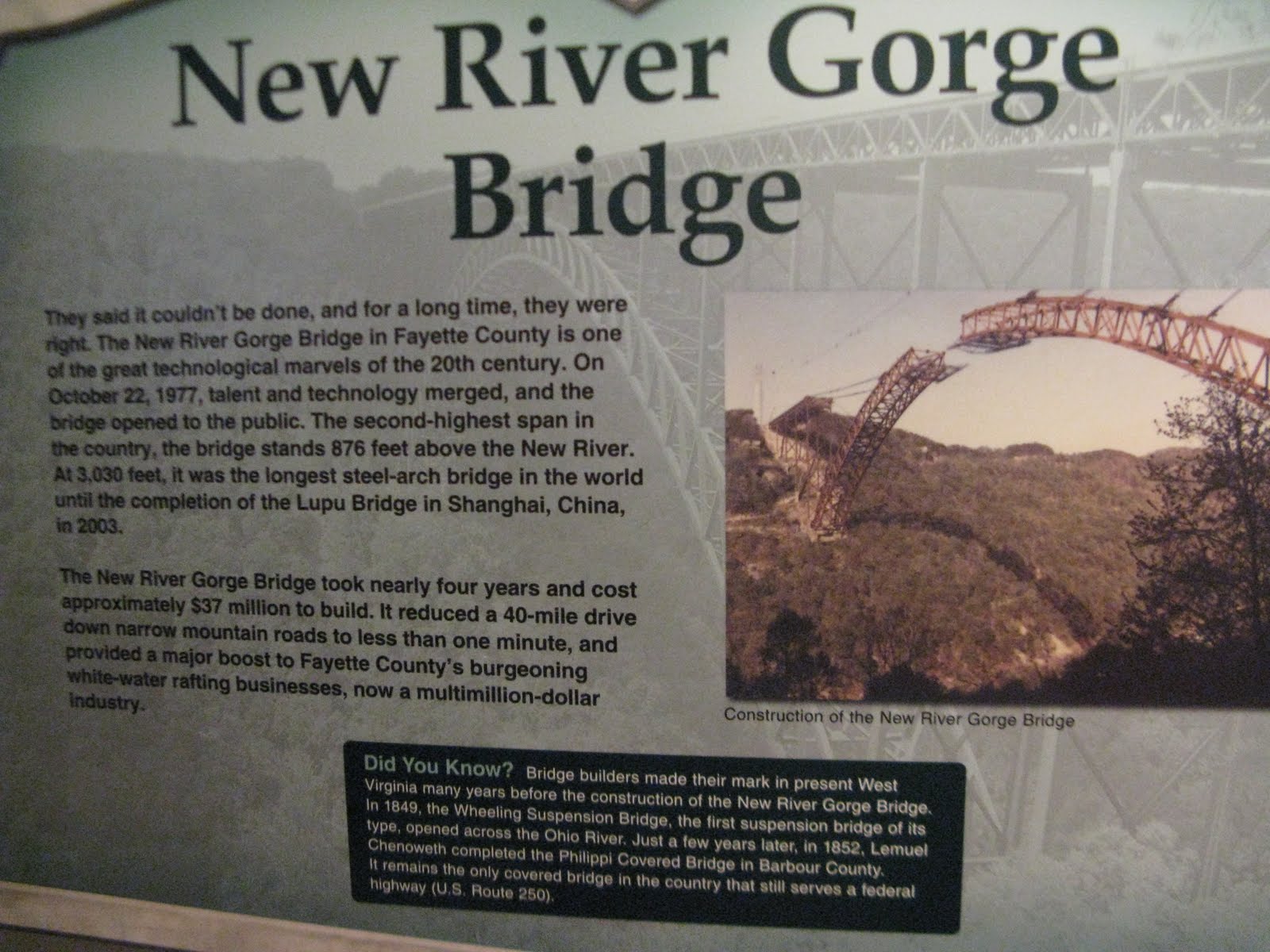
We didn't see either of these bridges, but I wish we had. They sound very impressive.

There are not a lot of campgrounds around Charleston, since there isn't much land that isn't completely covered with trees. We finally found the Rippling Waters Church of God Campground and Retreat Center. It was about 20 miles north of Charleston and about 4 miles off the highway down a winding, narrow road. We should have

unhooked the car, but we were lucky and didn't meet anyone on our way in. It was a really beautiful setting and there were very few campers. I highly recommend it, but I advise unhooking your tow vehicle before you drive in.

I was able to go for several nice hikes while we were here. It was so peaceful and secluded. I loved it here and would have liked to stay longer.

I'm not sure if this is a swan or goose or duck. But he just kept turning this way and that way, just as if he was posing for me.

We will be heading for my brother's in Ohio on Tuesday for my niece's graduation. We will be spending most of the summer visiting family and friends, so there probably won't be many blogs, unless we happen to stumble on something interesting.
Have a great Memorial Day.
Tarra


 On Tuesday, June 7th, we stayed overnight in Nappanee, Indiana at the Newmar RV factory and toured the factory the next morning. They provide free camp sites with water and electric. A lot of their employees are Amish, so they do not allow pictures. This picture was taken downtown at a strip mall where they had several hitching rails for their horses and buggies. The factory has a stable where they can keep their horses during their work shift. They are not allowed to use technology, such as cars, for pleasure, but they can use machinery for business. The owner of the factory is Amish, but owns an RV and an airplane for "business reasons". A lot of Amish women work in the local factories and ride bike to work. Amish refers to Jakob Ammann, a Swiss Mennonite of the 17th century, and his followers. The Amish workers in the factory all appeared to have the bowl-shaped haircut. The older men had very scraggly, gray beards, while the younger men had very neatly trimmed beards. The ladies we saw downtown wore dresses and bonnets. Their town motto was on several signs around town, "Embrace the Pace" with a silouhette of the back end of a buggy.