Monday, January 18, 2016

Florida, Minneola/Clermont and Kennedy Space Center


Sunday, Jan. 17th - Saturday, Jan. 30th
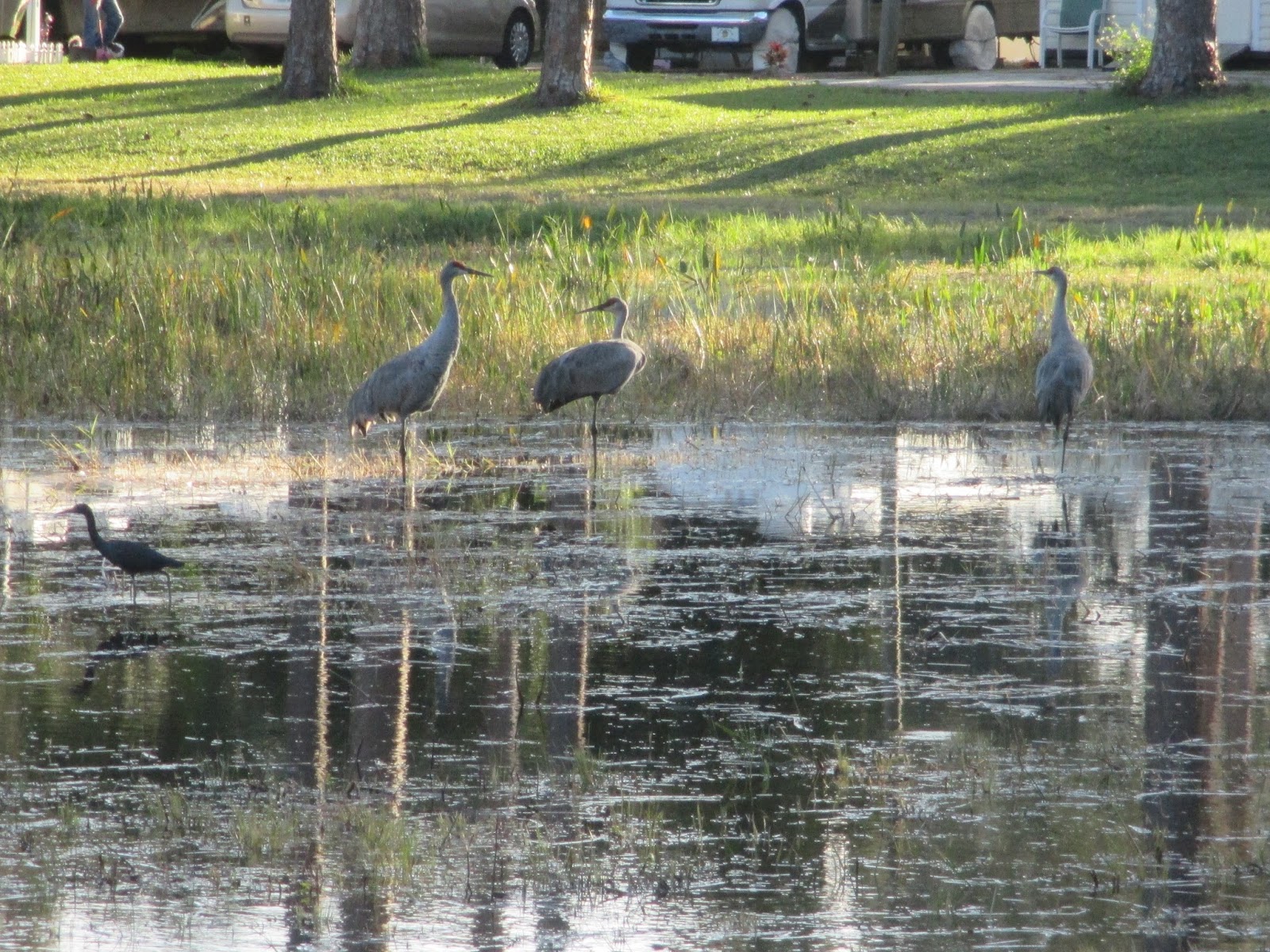

We arrived at Bee's RV Resort, about ten miles north of Clermont, on Sunday, got set up and drove over to Steak and Shake for a late lunch.  Yum, Yum!  We went for a short walk and these sand hill cranes were in the pond just a few yards from our camper.  Also, a small blue heron.  Monday we drove over to the visitor center and stocked up on reading materials.


On Tuesday the cranes were hanging around again, just like us, watching the locals play street golf around the perimeter of the pond.  Later we drove to Clermont to the movie Spotlight, which was very good, and came back to the campground for AYCE chicken dinner.


They were here most days when we walked by.   The oldest sand hill crane on record was at least 36 years and 7 months old, banded in Wyoming in 1973 and found in New Mexico in 2010.


Wednesday we biked part of the West Orange Trail from the Killarney Trail Head through the lovely little towns of Oakland and Winter Garden.  John went about 15 miles and picked me up another 7 miles down the trail.


This lovely little walking garden was at Chapin Station where we turned around to go back.


Besides the nice little towns you bike through, they have these really nice rest stations every six or seven miles with restrooms, playgrounds, biking supplies and rentals, and repair and air stations.


This was along the trail with an alligator and a duck, I think, and the years of the team championships.  The sign board says, "Some days nothing goes left".  I also saw a couple gators in ponds as I rode by.


Blue Pooch Spaw, mobile dog wash, parked at the Minneola Trail Head where John was waiting for me.  Several dogs were getting a bath.


Thursday I went back for a 32 mile bike ride while John went to do some shopping and errands.  This is just one of the magnificent old live oaks along the trail drooping with Spanish Moss.   Back at camp we went to the AYCE pot roast supper.
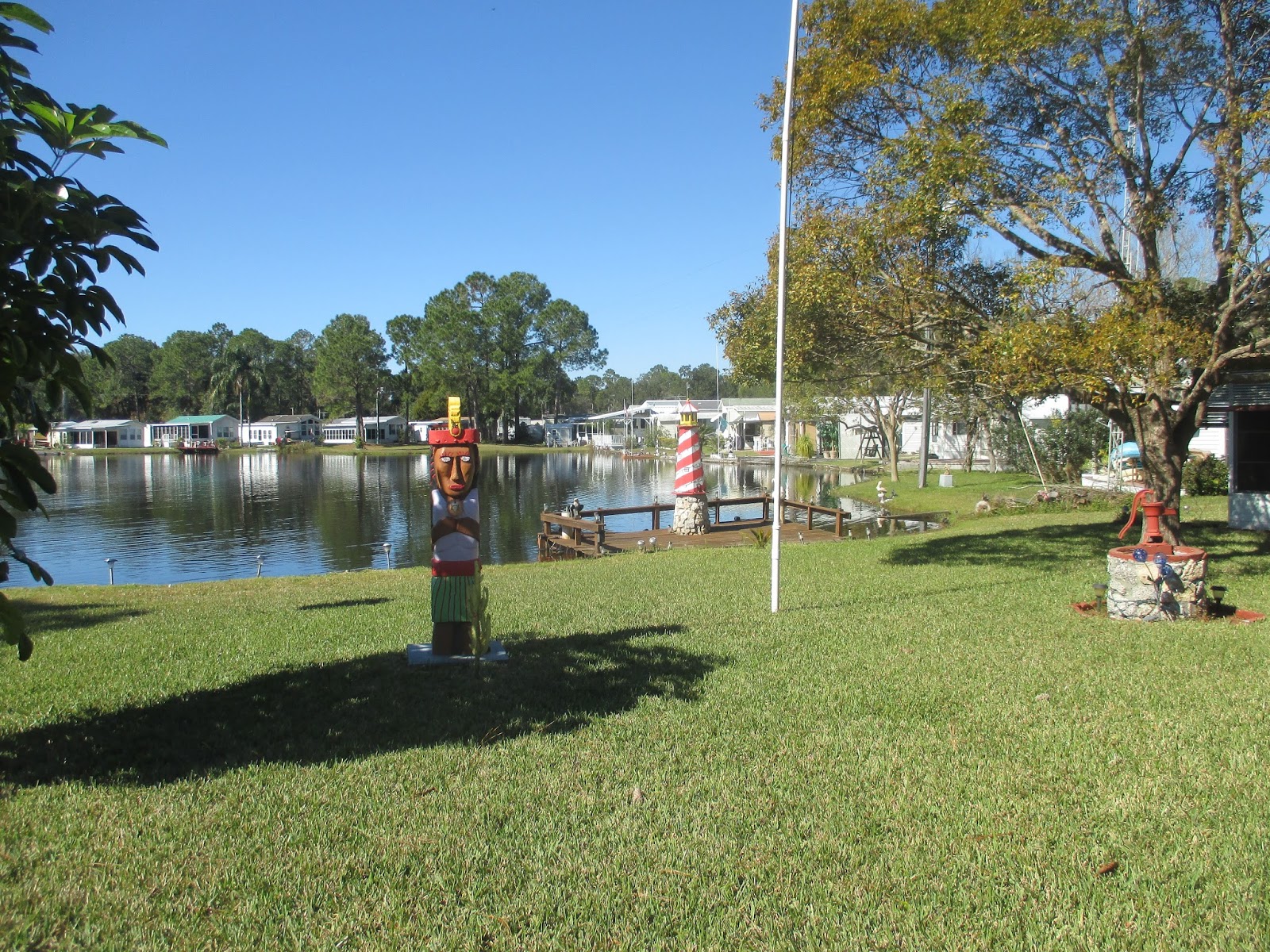

One of the ponds back at our campground where the signs remind you not to swim with or feed the alligators.  I certainly don't want to be their lunch, so I guess I'll stay out of the pond.  Friday it rained and we stayed at camp and went to the AYCE fish fry supper.  We have to get out of this campground.  The food is just too good and plentiful for our own good.  Saturday and Sunday were also cool and rainy.  In know you guys up north are all going, "Oh, boo-hoo."  But I was hoping to sit by the pool and get a little sun.


Monday we drove over to Merritt Island to tour the Kennedy Space Center.


Overview of the Vehicle Assembly Building (VAB) with launch pads 39A and 39B in the far distance.  The Space Center is in the middle of the Merritt Island Wildlife Refuge acquired by NASA in the early 1960s.  In July of 1963 the Launch Operations Center was established and renamed later that year for JFK, the president who put America on the path to the moon.  In 1975 nearly half of the Space Center was designated by Congress as part of Canaveral National Seashore.  The East Coast location is desirable because rockets leaving the Earth's surface traveling eastward get a boost from the direction of the Earth's spin.  The Cape Canaveral Lighthouse built in 1868 is the only fully operational lighthouse owned by the U.S. Air Force.


The Apollo/Saturn Vs were erected in the VAB on transportable structures known as Mobile Launchers.  Each consisted of a 380' steel Launch Umbilical Cord (LUT,) and a two-story launcher base.  The LUT provided service support and access to the rocket.  After it was moved to the launch pad by the Crawler-Transporter, the Mobile Launcher acted as a platform from which the rocket was fired. 


LUT model.  The top walkway 350 feet up (35 stories) is where the astronauts walk out to the module to board three hours before take off.


This is the actual walkway used by Neil Armstrong, Michael Collins and Buzz Aldrin on July 16, 1969 as they walked across this service arm from the umbilical tower to command module Apollo 11 on the Saturn V rocket.  Next stop: Moon's Sea of Tranquility.


The Crawler-Transporter used to move the Apollo/Saturn V rockets and mobile launchers from the VAB to the launch pad 3.5 miles away.  It is now used to transport Space Shuttle vehicles and travels at 1/2 mile per hour.  Notice the size of the semi-truck parked just to the right of it.


This is a spare crawler cleat that weighs 2,000 pounds.  There's a small model of the crawler in the picture above.  It has eight tracks and each track has 57 of these cleats.  The crawler is 141 feet long, 114 feet wide and 20 to 26 feet high (adjustable).  It weighs six million pounds with a load capacity of 12 million pounds.  Its maximum speed is 1 mph loaded and 2 mph unloaded.


A 45 minute bus tour took us out past the VAB and the two launch pads.  We saw an alligator along the way and this bald eagle.  Merritt Island is a barrier island and it is a buffer zone protected from development along the Atlantic Flyway providing a resting and feeding place for thousands wading birds, shore birds and song birds.


There are at least 12 bald eagle nests in the area around the launch pads.  The nests can reach more than six feet in diameter and they keep adding to them each year.  They mate for life and produce one or two chicks per year.  This particular 800 pound nest way up in the tree on the left is larger than a king size bed and over fifty years old.  The same nesting pair has been coming back to it for at least 28 years.  Our bus driver said that once the children are out of the nest they are not allowed to return.  And I said, "But the grand children are always welcome!"


Command Central.  We were told that today's smart phones have way more technology in than the Saturn V had.


The Saturn V is over 36 stories tall and over 6 million pounds (as heavy as 7 Boeing 747 jumbo jets) requiring over 7.5 million pounds of thrust generated by five F-1 rocket engines.  In less than three minutes it is going 6,000 MPH, is 40 miles above the Earth and has consumed 534,000 gallons of fuel.  It will eventually reach 24,000 MPH enabling it to leave Earth's orbit.  The propellants in Apollo/Saturn V weighed 5.6 million pounds, 91% of its total weight.   The blast off is the loudest man-made noise ever produced with the exception of a nuclear explosion.


These are the locations on the Moon where our astronauts have landed.  Eugene Cernan was the last man to step on the lunar surface, but he prefers to be called the "most recent" rather than the last.


The first stage of the Saturn V generated approximately 160 million HP equal to over 213 F-18 jet fighters.  More than 400,000 non-astronauts contributed their ideas and imagination, expertise and inventiveness, dedication and skill to put Americans on the Moon.  The Kennedy Space Center had over 17,000 engineers, technicians, mechanics, contractors and managers.  500 people worked several years just developing the space suits.  For the Apollo 14 capsule 14,000 people and 8,000 companies worked on the millions of components of the command module.  It had 15 miles of wiring alone, enough to wire 50 two-bedroom homes.


Lunar Module Trainer full size replica 7' 8" in diameter.  The pilot and commander flew it standing up, as it was designed without seats to reduce weight.  It was replaced by the Lunar Rover.


The Space Shuttle Atlantis Museum.  We came back on Friday to finish going through the Kennedy Space Center.  It took us two full days and we'll have to come back another day to check out the Merritt Island Wildlife Refuge.


Model of the Atlantis Shuttle.


Loading up the cargo space to take supplies to the International Space Station (ISS).  After 126 million miles of space travel, the Atlantis landed here to be on display with exhibits and simulators.  The Space Shuttle Atlantis, NASA's 4th space flown shuttle, debuted on April 6, 1985, was in service for 26 years and flew 33 missions.  It launched as a rocket, flew as a spacecraft and landed as a glider.  It has over 2.5 million parts with the history of each and every part documented by engineers.  207 astronauts flew on Atlantis spending 307 days in space with the last mission being July 8-21, 2011.  Most of the ISS was hoisted into space by the space shuttle one piece at a time.  Then astronauts went on 160 space walks to put the pieces together.  The five Orbiters (Columbia 1981, Challenger 1983, Discovery 1984, Atlantis 1985 and Endeavor 1992) flew 135 missions.


Granny driving the Shuttle.  Go Granny, Go Granny, Go Granny, Go!


One of the many play areas for the kids.


Full scale model of NASA's twin Mars Exploration Rovers built in 2002 by the LEGO master builder team.  With approximately 90,000 LEGO elements, it took 650 man hours to construct.  It weighs 290 pounds.  The actual battery-powered, four-wheel drive Rovers weigh 410 pounds and continue to explore the Red Planet and send new information to Earth.


The Combined Operational Load-Bearing External Resistance Treadmill named for Stephen Colbert, known for his political satire and loyal fans.  Colbert had announced he was running as a write-in candidate for the naming of the new node on the International Space Station.  They named it Tranquility, but gave him a nod by naming the state-of-the-art treadmill for him, even creating a patch for the occasion.


Space toilet where you have to line yourself up perfectly over the target, turn on the vacuum, perform and, most important, clean up!


And, of course, the patch proudly worn by the team that designed and created this necessary wonder.


Each astronaut had a little bunk like this about the size of a phone booth, for those who remember what a phone booth is.  On the left is a sleeping bag pocket to tuck yourself into and all the little things you want near you in bed are just stuck on the walls with velcro.


Replica of the Hubble Telescope.


Air Stream Astrovan that carried the astronauts to the launch pad for training and launches for 27 years starting with the 9th Space Shuttle mission.  Breakfast is always steak and eggs, a tradition started on the first American manned space flight.


Challenger left side body panel January 28, 1986.  The Challenger flew ten missions starting in 1983.  They had the first person to do an untethered spacewalk,  They had the first crew to include a woman and the first African American to fly in space.  They were the first Orbiter to land at Kennedy Space Center after a mission.  They were lost during an explosion at launch in 1986. 


Pictures of 43 tons of debris collected after the Columbia disaster.  Columbia flew 28 missions starting in 1981.  It was the first Orbiter to fly in space and had the first female shuttle commander.
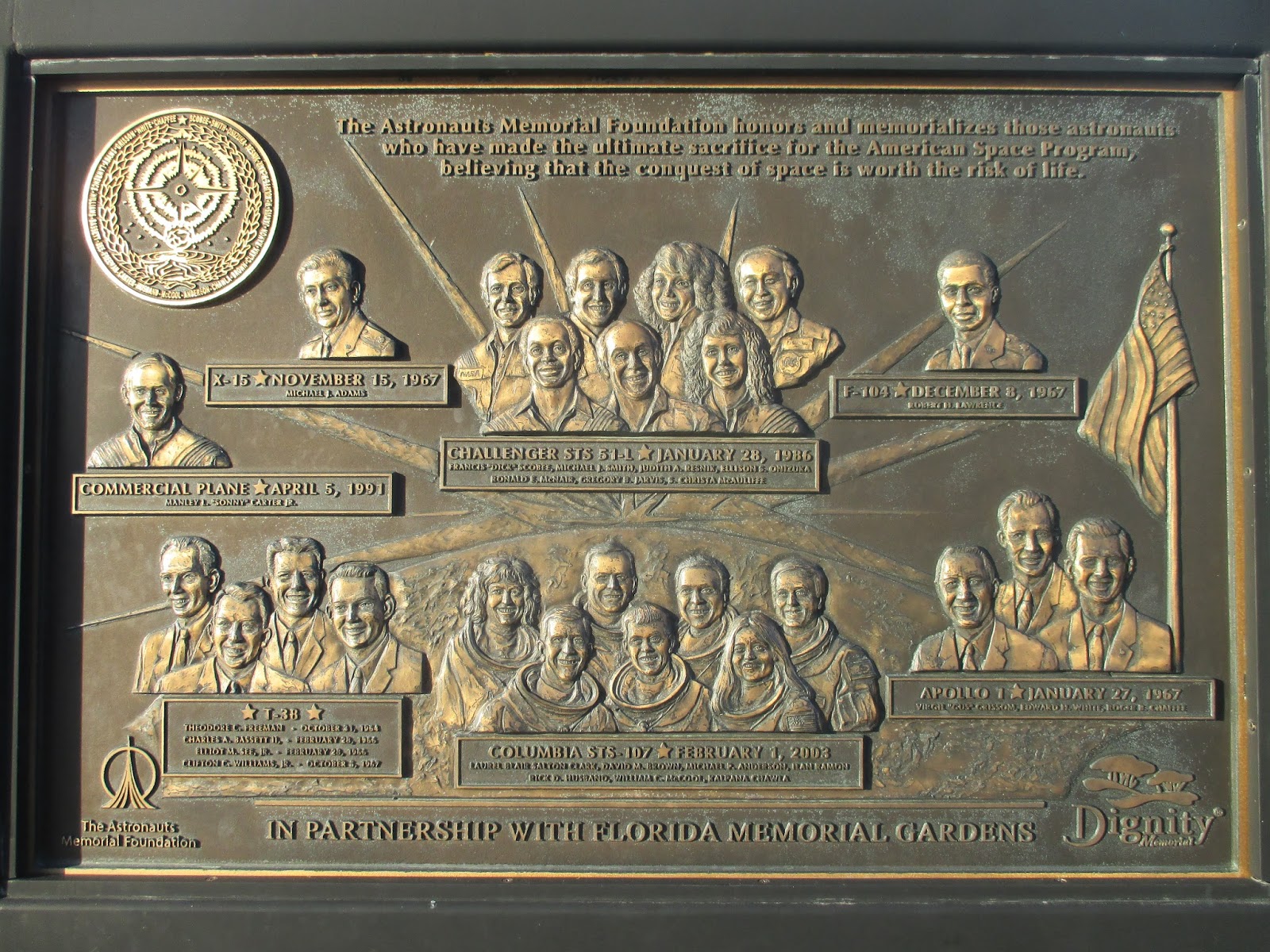

Plaque with all of the astronauts who have been lost on missions or training exercises.


"The future doesn't belong to the fainthearted, it belongs to the brave."
President Ronald Reagan


The names of lost astronauts randomly drifting in outer space?


Back side of the memorial, I think meant to look like the space station or maybe the rocket and launch pad.


NASA maintains a fleet of Northrup F-38 Supersonic Jets used to keep the flying skills of the crew up to date.  Rigorous training missions put the crews in situations that require them to practice working together with concentration and team work.  This 1965 Talon can take off with as little as 2,300' of runway, climbing to 30,000 feet in one minute with speeds of 990 MPH and is used as a space flight readiness trainer.


Mural of the International Space Station.


As you first enter the Space Center, you walk by the Rocket Garden where all the rockets are the real deal, except for one replica.  There is a very interesting 15 minute talk every hour explaining the history of the space program and how we were somewhat forced into it by Russia during the Cold War because of our fear of what they might do and our embarrassment of them beating us in the space race.


The building in the rear is where you can meet and greet astronauts and have lunch with them and get their autographs.  The orange in the left-hand corner is the original 35th story walkway into the Saturn V that Armstrong, Collins and Aldrin walked on, that you can also walk on here in the Rocket Garden.


One last look at the Rocket Garden on our way out.


"For the eyes of the world now look into space, to the moon and planets beyond, and we have vowed that we shall not see it governed by a hostile flag of conquest, but by a banner of freedom and peace."
John F. Kennedy


Sunset as we leave the Kennedy Space Center and Merritt Island Wildlife Refuge.


The Showcase of Citrus fruit stand.  Check out the alligator and the snake on the roof.  They have all kinds of yummy homemade goodies here, jams, sauces, relishes, wines, slushies, snacks, etc.  They've got little wagons you can pull out to the orchards and pick your own oranges, lemons, grapefruit, etc.  They have a playground, petting zoo and tepees for the kids and a picnic area and they do birthday parties.


They give Swamp Truck rides over their 2,000 acres in these big machines.


Walking the nature path at our campground.


This fellow in our campground has a Confederate flag and an American flag hanging on the side of his little trailer.  He also drives a little golf cart around with a Confederate flag drooped over it.


The warning sign by the tree says, "You are entering a RED NECK AREA.  You may encounter American flags, Armed Citizens, The Lord's Prayer and Country Music.  Proceed at your own risk."  It must say something about your mind set if you consider the Confederate flag to be one of the American flags?


This sign was also in front of his place.  I take it to mean Keep Your Dogs Out of My Yard!


Saying goodbye to the sand hill cranes Sunday, as we head to the Thousand Trails campground about ten miles south of Clermont and a few minutes west of Disney World for the next two weeks.

Tarra

Sunday, January 3, 2016

Mobile, Alabama to Pensacola, Florida

Sunday, Dec. 27th - Sunday, Jan. 3rd


Saturday we moved to Wilderness RV Park near Robertsdale, Alabama, just east of Mobile and north of Pensacola, Florida.


On our way down to Pensacola on Sunday, we stopped at the really nice Florida Visitor Center.  This monument there honors the Blue Angels who are based at Pensacola.


At Pensacola we drove down Perdido Key and went for a walk on Johnson Beach with beautiful sugar white sand.


As we were walking we started to see lots of these Portuguese Man o' War jellyfish.  They are not actually jellyfish, but siphonophores, a colony of four organisms that cannot exist on their own.  There are three species, the Atlantic, the Pacific and the Blue Bottle.  They can be seen on Florida beaches from October to February, but are most common in Nov. and Feb.  They live on the surface with a gas-filled bladder and have no means of propulsion, so they are moved by the winds, currents and tides.  They can briefly deflate in the event of a surface attack.  They can be 3 to 12 inches long and almost 6 inches high.  Their tentacles can dangle underneath the water for up to 165 feet, depending on their size.  They are common on the lower east coasts of Florida in times of east and southeast winds.  Their tentacles are covered in venom used to paralyze their prey and may remain potent for hours or even days after their death.  They are a common part of the diet of the loggerhead turtle, as their skin is too thick for the venom to penetrate.  The Atlantic coast species has the nastiest sting, but they are all very painful.  The Atlantic is the largest species and the Blue Bottle is the smallest.  They cause whip-like red welts, stinging, burning and swelling of lymph nodes.  If a person is sensitive to the venom, it can cause a severe reaction including difficulty breathing and cardiac arrest.  It is a neurotoxin that is 75% as powerful as cobra venom.  Welts can last from minutes to hours.  There have been more than 200 swimmers stung this past week at Fort Lauderdale.  Hollywood had 92 stings on Monday.  Boca Raton is reporting 10 to 15 a day and Miami Beach has had 1,020 since Christmas Day.  Its name comes from 18th century armed sailing ships and their resemblance to the Portuguese version at full sail.  It's nickname is the "floating terror" and now you know why.  I'm glad I didn't try to pick one up!  There were actually a bunch of kids playing in the water.  We stopped at the Crab Trap Restaurant where we had crab cakes, fried shrimp and shrimp gumbo.  Yum, Yum!


Monday we drove into the nearby city of Spanish Fort and saw the movie Concussion which was very good.  We ate supper at Zaxby's (okay,but not as good as Raising Cane's) before heading back to camp.  Tuesday we went back to Pensacola and drove out to Fort Pickens where we found a really nice campground to stay at next time we come this way.  We drove as far as Fort Walton just looking around and grabbed a late lunch at KFC on our way home.  Wednesday we drove over to Mobile and went through a very nice little free museum in this replica of the original Fort Conde.  It was named for King Louis XIV's bother and was built in 1723 by French Canadians to protect their colonial empire, La Louisiane.  In 1763 at the end of the Seven Years War France lost all its colonial possessions in North America.  In 1818 the U.S. Congress sold the fort and within five years nothing remained.  The Gulf Coast colonies were a place to send Europe's unwanted citizens, such as orphans, unemployed, pick pockets, smugglers, debtors and indentured servants.  Exiling undesirables ensured the colonies would be populated.  One observer wrote the entire region was "the secret asylum of pirates and vagabonds who had escaped from their creditors and from justice."  140 years later the Alabama Department of Transportation began building the Wallace Tunnel and unearthed thousands of artifacts from the fort.  I guess that's when they decided the fort would be good for tourism and rebuilt it.  Now it's their Visitor Center and and has this nice little museum.


This is bigger than his current living quarters.  He might like it here.  They do have TV and internet in prison nowadays, don't they?


Then we went kitty corner across the street to the History Museum of Mobile.  Originally called Fort Conde, the locals referred to it as Mobile, a French word for the nomadic Indian tribes who lived in the area, and it stuck.


They have a nice collection of buggies and carriages, but I liked this little goat cart.  It was made for a young boy named George by his father.  Every day little George drove it to the Southern Market (the museum building we are in) to pick up knives and saws from the butchers to be sharpened by his grandfather.  Imagine sending a young child by himself today to pick up knives and saws.


Famous boxer Joe Louis from Lafayette, Alabama served in the U.S. Army in WWII and became a national spokesman for the Army, traveling around Europe.  From 1940 to 1944 Mobile was the nation's fastest growing wartime city, going from a population of 114,906 to 201,369, with 50,000 employees in the shipyards.  They built nearly 200 ships, freighters, minesweepers, cargo ships, tankers, destroyers and Liberty ships.  It was also a national center for ship building in WWI and was chosen as one of several sites for a government sponsored project to build ships using poured concrete, when steel was expensive and in short supply.


Dorothy Doll with her ruby slippers and Toto.  "There's no place like home, no place like home, no place like home."


There were lots of little doll house Christmas scenes, but this one was so tiny, it was inside a coffee mug.


Then there was a room with doll house size models of some of the mansions around town.


So beautiful, just makes me wish I could live there!


This room had a huge, long dining table set with a different set of china at each place and lots of beautiful serving dishes, candle sticks, etc.  Each place setting had a Mardi Gras invitation next to from various years, some very old.  This is an 1882 dance card.  They were popular in the 1800s and early 1900s.  Women penciled in their intended dance partners for each song at formal balls.


Antique bath tub.


Swords disguised as walking canes were popular in the 1800s.  Gadget canes also held flasks of alcohol, compasses and other tools.


The trains of the Mardi Gras Queens are as much as 20 feet long.  Mardi Gras has its roots in Ancient Rome and has since spread around the world.  Outside the U.S. it's often called Carnival, a Latin term meaning "farewell to flesh".   From the Italian word carnovale which is from the Latin words carnem (meat) and levare (lighten or raise), literally to remove the meat or stop eating meat.  Fat Tuesday is the last day and the high point of a long party season.  The season of feasting begins about two weeks before Lent, a season of fasting.  It is celebrated with colorful parades, formal balls and parties serving traditional foods including King Cake and Moon Pie.  The early Europeans celebrated the coming of three wise men bearing gifts 12 days after Christmas on January 6th.  The day is known as "The Feast of the Epiphany" or "Twelfth Night", traditionally the beginning of the Carnival season.  The King Cake is crown-shaped and is a cross between coffee cake and a French pastry.  A tiny baby Jesus is hidden in the cake and the person whose slice it is in must bring the King Cake to the next gathering.  Moon Pie is a traditional "throw" of the mystic societies in Mobile.  The trademarked name of the original graham cracker and marshmallow cookies was created by the Chattanooga Bakery in 1917.  Mystic societies are clubs that celebrate the Mardi Gras season.  Some have parades and others simply hold a formal ball (by invitation only).  The Mobile area boasts over 60 active mystic societies.  Each has a King, Queen or both and a unique history.  Catching throws at a Mobile Mardi Gras parade is a full-contact sport.  It's every man, woman and child for themselves.  Moon pies, bags of peanuts, bubble gum, candy, cups, koosies,  frisbees, beads, stuffed animals and doubloons.  Doubloons are colored aluminum coins with the date, organization's logo and parade theme stamped on them.  Mobile has a unique phenomenon called Joe Cain Day the Sunday before Fat Tuesday.  It is dedicated to the man who revived Mardi Gras after the Civil War.  A group of "Merry Widows" dressed in black pay homage at his grave and home site followed by the Joe Cain procession also known as the "people's parade".


Native Henry L. "Hank" Aaron born in 1934 was major league baseball's "Home Run King".  He played for 23 years and hit 755 home runs.  Hammerin' Hank broke many baseball records and was the National League's MVP in 1957.  He is probably best known for hitting his 715th home run in 1974, breaking the previous record set by Babe Ruth.  They have on display his 754th home run baseball that he hit in the second game of a double-header against the Texas Rangers on July 11, 1976.  Hank's career record was 2,297 runs batted in.  Leroy "Satchel" Paige born in 1906 was one of baseball's best-ever pitchers, but because black Americans were barred from major league teams until 1947, he didn't join the Cleveland Indians until 1948 at 42 years of age.  In 1971 he was the first African-American player inducted into the Baseball Hall of Fame.  Paige honed his pitching skills during the five years he spent in reform school.  His nickname originated from his job handling baggage at the railroad depot.  Lots of Mobile players made it to the major leagues.  Do you recognize any?  Hank's brother Tommie, Frank and Milt Billing, Jim Mason, Willie McCovey, Ozzie Smith, Eddie Stanky, Billy Williams, and Tommy Agee,  Cleon Jones and Amos Otis who together manned the outfield for the New York Mets as they won the 1969 World Series.


The temporary exhibit was King Tut artifacts, but we saw the original, endless display of artifacts from his tomb at the national museum in Cairo, Egypt.


Greek Orthodox Church at Malbis Plantation in Daphne, Alabama.  It's supposed to be fabulous inside, but it was locked Thursday when we stopped.


From there we continued our road trip over to Biloxi, Mississippi just to look around.  It's kind of casino alley right along the coast there.  Lots of grand new casinos since Hurricane Katrina.  But in amongst them is tucked the home and museum of Jefferson Davis, President of the Confederacy.  We will have to check it out next time.


We had a late lunch of shrimp, french fries, hush puppies and cole slaw overlooking the water and headed home for a quiet New Year's Eve and New Year's Day.


Saturday we drove back to Pensacola to see the replicas of Columbus' ships, the Nina and the Pinta.  They were docked at the Perdido Key Oyster Bar and Restaurant on the Intracoastal Waterway.  The puny little boat in the middle is named Gettin' Bye.  Santa Clara was the original name if the Nina.  Ships of this era were always named after saints and nicknamed by their owners.  It was owned by the Nino family and became Nina.  It is a typical trading vessel of the 1400s.   Both ships are caravels, a lighter, faster ship style developed in 1415 under Prince Henry the Navigator (son of King John I of Portugal) to stop the invading Barbary Pirates from the North African coast.  Vasco de Gama was a member of the Knights of Christ (modified name of the Knights Templar).  Prince Henry was Grand Master of the order.  They functioned well into the 16th century with members devoting themselves to maritime activity. 


The Pinta was 85' long and 100 tons and both ships were built in Brazil by 8th generation Portuguese shipwrights.  It took 20 men 36 months and was completed in 2005.  It is actually 15' longer and 6' wider than the original.  The original had 26 men aboard and all lived, worked and slept on deck.  The "hold" below was for supplies, food and fresh water.  It took Columbus and his men about 30 days to sail from the coast of Spain to the Canary Islands.  There they refitted their sails and re-provisioned and set off for Japan.  They saw land about 30 days later in the Bahamas.


This is a photo of the men in Brazil as they were building the ships.  Both ships were built completely by hand using only adzes, axes, hand saws and chisels, no power tools.  After many years of research and three years of construction, the new Nina set sail from Salvador, Brazil with a crew of 11 (the original had 24).  Their first port was 4,000 open ocean miles away at Punta, Arenas in Costa Rica where she was filmed for the movie "1492" for the 500th anniversary of the voyage.  She has traveled to over 1,000 ports in the Western Hemisphere in the Pacific and Atlantic Oceans, the Great Lakes and the Mid-western River System.  Her longest voyage so far is 5,200 miles in 31 days at sea.  The Nina has made five trips to the West Coast and ten trips through the Panama Canal.  Since the Pinta was finished, they have travel together as a new and enhanced "sailing museum" for the purpose of educating the public and school children.  The Caravels were used by many early explorers and historians call them the space shuttles of the 15th century.


This sign was on the pier next to the ships.  It sounds like it would be a great adventure.  Maybe you should check it out, Steve.
 

Looking for a place to eat, we stopped at the Flora-Bama Oyster Bar and Grill.  It's this huge, old ramshackle place that has been destroyed by hurricanes and fire and rebuilt each time.  They have live music 365 days a year and a polar plunge in the ocean on New Year's Day with hundreds of people taking the plunge and a huge party afterwards.  They had three live bands today at 1:00 PM, 5:00 PM and 10:00 PM.  The band playing when we came in was Jezebel's Chill'n and they were really good with an awesome female singer, but too loud for the old man I live with, so we didn't stay.  Jodi, you and Claude would love this place!  Music trivia:  Jimmy Buffett was born in Pascagoula, Alabama and grew up in Mobile.


We were upstairs looking down at the band and dance floor.  The ropes hanging above the dance floor are loaded down with bras about five deep everywhere.  I think they have some pretty wild times here.  This place is right on the Florida/Alabama state line and right on the beach.  They have a huge gift shop and several outdoor decks both upstairs and downstairs.  We ate a What a Burger, a fast food place, but they have excellent burgers.  They are everywhere down here from Texas over.

Sunday we are moving a little further south toward Panama City.
Happy Sailing,
Tarra