Saturday, May 8, 2010

Sparta, Wi. & Owatonna & Sleepy Eye, Mn.

Tue - May 4th

Sparta, Wisconsin claims to be the "Bicycling Capital of America". The statue is of Ben Bikin' on the "Largest Bike in the World" at their tourist information center in the city park.


There are many biking trails in this area and into Minnesota. We stopped at the Deke Slayton Memorial Space & Bicycle Museum in Sparta. Donald K. (Deke) Slayton graduated high school here in 1942. He was one of the first seven Mercury astronauts. I'm not much into astronauts, but they had a lot of his stuff there.


On the main floor they had the usual county history stuff about pioneering and settling, plus antique hats and dresses and this doll collection with Barbies, Kens, Allans, Midges and Skippers.


The bike museum was on the second floor with the astronaut stuff. This bike was ridden by a woman from Sparta in the Ididasport as described in the next photo.


This is an excellent museum.


In the 1890s when ladies bicycling costumes first appeared, men were prone to snickering. High society did not accept such apparel in fancy eateries or hotels. A Chicago man laughed when seeing the bloomers being worn, but the wearer had him arrested and he was fined $10.00 plus costs.


How many of you could keep up with this old duffer. I, for one, am impressed!


This is Louis Sullivan's National Farmers Bank Building, now Wells Fargo Bank, in Owatonna, Mn. It is supposed to be the most beautiful bank in the world. It was built in 1906 and is a National Historic Landmark.


This is the view of and above the tellers as you walk in the front dooor. The ornate clock is the focal point. There is a farm scene mural on each wall, but this one has been partially covered by a balcony they put in for viewing the lobby. There are more than 200 colors in the terra cotta detailing along the ceiling and on the arches above the murals. Terra cotta is a hard, ceramic-like clay.

There are four of these electroliers (electrically lit chandoliers), one in each corner of the lobby. Each one weighs 5,500 pounds and is designed to resemble a blooming flower. The lobby is 60 feet square and 49 feet high and is designed to resemble a giant treasure chest. It is referred to as Sullivan's "Jewel Box".


In 2009 every piece of stained glass was removed and carefully cleaned. The ironwork was repaired and the stained glass windows and skylight were re-leaded.


This shows one of the murals and the office cubicles below it with their trellis work ceilings and built-in lights.


This is a statue of the Indian chief that Sleepy Eye, Mn. was named after. We stopped here and hiked the three mile paved trail around the lake. They have a very nice park by the lake with camping sights.


We are back in our hometown of Brookings, SD. for a couple of weeks, minus a few days over the weekend to spend with our daughter in Sioux Falls. We will be camping with friends over Memorial weekend and then heading north to visit my family, so probably no blogs for a while.

Happy camping,

Tarra


Monday, May 3, 2010

Anamosa & Dubuque, Iowa and Madison & Ripon, Wi.


Mon, Tue, Wed - April 26th, 27th, 28th


This is the Anamosa State Penitentiary, built in the 1890s. It is huge and includes a whole wing for women. They also have working prison farms and a prison cemetery. There is a museum which was closed the day we were there. It is built of local stone from Stone City just a few miles away. All of the buildings in this quaint little village of Stone City are made of this stone. The Grant Wood Art Gallery (American Gothic) and the National Motorcycle Museum are also in Anamosa.


Views of the Mighty Mississippi at Dubuque, Iowa.


River Walk with sculptures along the way. There is a shot tower behind the building that now has shopping in it. Shot towers were used to make bullets by pouring hot lead in at the top. As it cooled on it's way down, it formed into a bullet. Lead was mined in the area, called the Mines of Spain, because it was owned by Spain at the time.

Sisters of Charity of the Blessed Virgin Mary, Mt. Carmel Home Care high up, overlooking the third largest river in the world. Just a little more inspiring architecture.


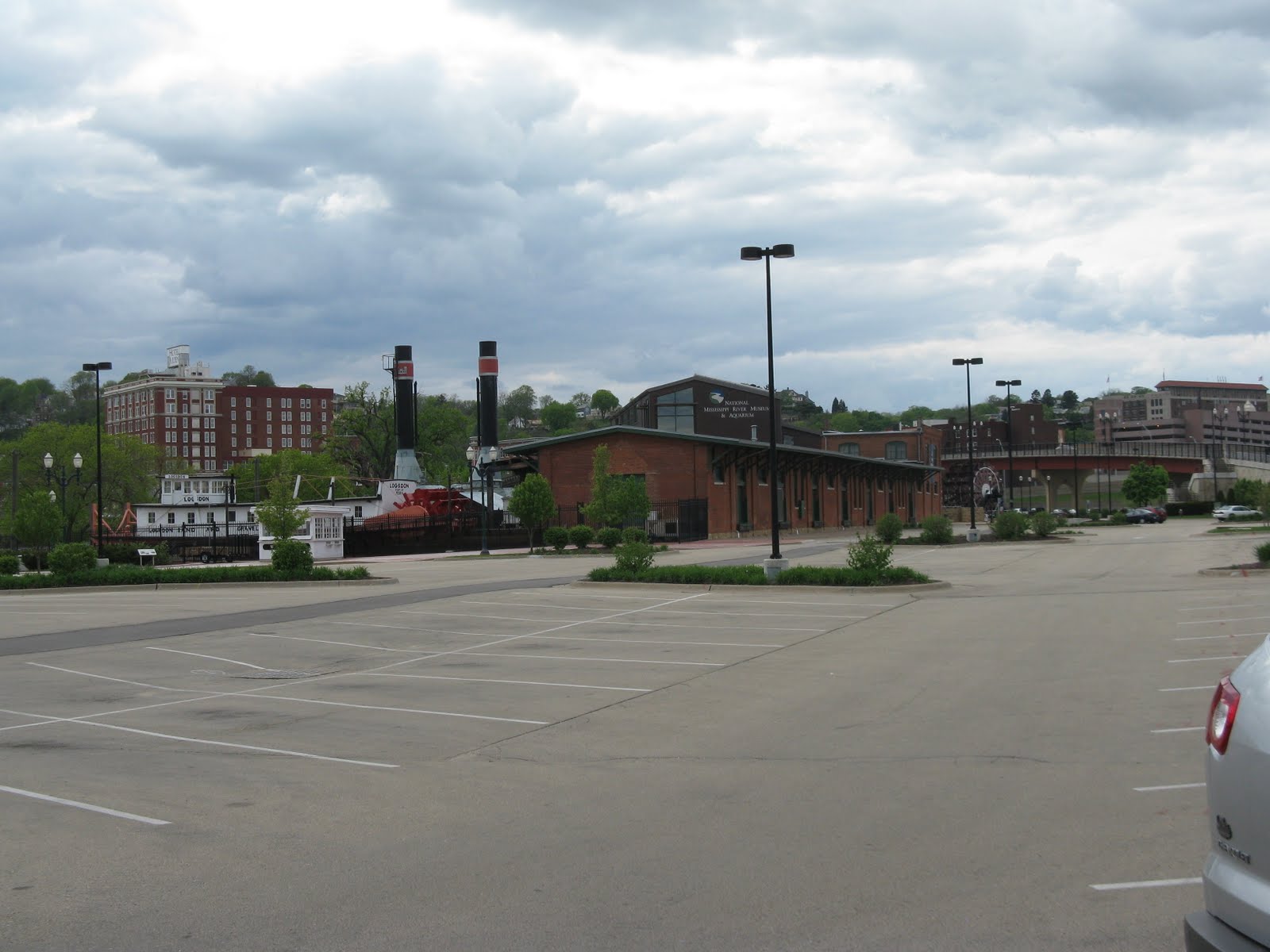
National Mississppi River Museum & Aquarium. This is a wonderful museum with great videos and interactive stuff. They have river wildlife including birds, fish, turtles, frogs, alligators and lots of lizard varieties.


Here's a strange looking lizard.


And here's an even stranger one.

Trivia: Did you know the world's largest lizard, the Komodo Dragon, can get up to 150 pounds and 10 feet long. One 92 pound dragon was recorded as eating an entire 66 pound pig in 17 minutes.


The museum includes outdoor displays of boats and other stuff on the river, too. This dredging boat can be stayed on overnight, including a meal, museum ticket and tour of the boat for $98.00.


Fenelon Place Elevator, also known as the 4th Street Elevator is the world's shortest, steepest, scenic railway at 296 feet in length. Views of Iowa, Illinois and Wisconsin. Open April thru November.


Courthouse and connected jail in front. I just snapped this quick, as we were driving by. Aren't digital cameras amazing?


Arboretum at Marshall Park. Not very many flowers blooming yet, but it was still quite beautiful.


I'll bet you're all jealous, now that you've seen my man will actually put his head in a lion's mouth for me. He has always said that there is nothing he won't do for me and that he treats me like a goddess. I guess I can't argue anymore. "If only", he says.

Lock number 11 on the Upper Mississippi River. Everything from the Rockies to the Alleghenies, including the Missouri, drains into the Mississippi.


These are views from our campground, which is just a little way down from the locks. Our campground was just behind the Mystique Casino where they have greyhound dog races.


The area from Dubuque, Iowa to LaCrosse, Wi. is referred to as "The Little Alps".


Wisconsin State Capitol at Madison, situated on an isthmus with Lake Monoma to the east and Lake Mendota to the west. The first state capitol was at Belmont for only 45 days where only one decision was made. You guessed it, the decision was to move it to Madison. The first capitol in Madison was torn down after 25 years because it was too small. The second one burned down in 1904. It was replaced over 11 years for 7.2 million dollars. It has 43 different kinds of stone and marble from France, Italy and Tennesee. In places you can see fossils of starfish and anemone in the marble. This is an exact replica of the Liberty Bell except for the crack. In the 1950s, France gave 55 of them to each state, territory and the District of Columbia. It has the only granite dome in the United States and is the largest dome by volume in the U.S. It has glass floor tiles on the third floor to let some of the light from the sky lights through to the floors below. Just below all the light blue squares in the upper part of the dome, it looks like a band of gold trim. It is actually a walkway and railing, to give you some idea of how big it is. The Wisconsin Assembly had the first electric voting machines in the world.

There are badgers many places throughout the building, as it is the Wisconsin symbol. It comes from when the first lead miners dug holes in the sides of hills and lived in them. They were referred to as badgers. Legend says rubbing the nose of this badger just outside the governor's conference room will bring you good luck. This room was designed after a small chamber in the Doge's Palace in Italy. There are 26 historical paintings on the walls and ceiling of the Governor's Conference Room all done by the same artist. He was paid $25,000.00. The capitol was restored and renovated from 1988 to 2002 for just under $160 million. Part of "Public Enemy" with Johnny Depp was filmed here because it looks so much like our nation's capitol, except that it is actually 16'2" taller than the U.S. capitol. They get 1,000 school kids a day touring through this time of year. John says no big deal, that's just two bus loads.

"Fat Bruce's" in Ripon, Wi. sounded like a good place to eat, but John voted against it.


We just stopped in Ripon to see the birthplace of the Republican Party in this small school house.


We didn't find out till after we left that there is an even better place here, the Ripon Good Cookie factory where you can eat all the free samples you want and buy lots of cookies to take home. Good thing we didn't know. It might have been a worse mistake than "Fat Bruce's" restaurant.

We finally arrived at Wrightstown on the Fox River to visit with cousins and enjoy their river view with them for several days.

Off to Minnesota Tuesday, May 4th. Back home in Brookings by Friday.
See you all there.
Tarra

Iowa City, Hoover, Amana & Amish

April 22, 23 & 24


Original Iowa capitol at Iowa City. The capitol was later moved to Des Moines and the building was given to the university. They planned their campus around it, four buildings built out from it in each direction. It was originally referred to as the "Five Spot" and later changed to the more dignified "Pentacrest". It has a reverse free-standing staircase. There are only two in the country.


It was a very cold, rainy and windy day and the apple blossoms falling made it look like it was snowing in this sculpture garden on campus.


This is one of the sculptures in the garden, entiltled "Dorothy".


Just a few miles south of Iowa City is Riverside, the birthplace of Captain James T. Kirk of the Starship Enterprise. For all of you Trekkies out there, they have the Voyage Home Museum and an annual Trekfest with further information to be found at http://www.trekfest.com/.


Also, near here is President Hoover's birthplace and museum at West Branch. This is the museum.


The graves of Herbert Hoover and his wife, Lou Henry Hoover, are at the top of this hill overlooking the museum and his birthplace. In keeping with the Quaker ideal of simplicity, there is no presidential seal or inscription, just their names and their birth and death dates.


This is the two-room home built by his father and grandfather where he was born. In the background you can see the blacksmith shop where his father worked, just next to the schoolhouse.


Hoover was a Quaker and this is the meeting house where they would gather and sit in silence for hours waiting for the spirit to touch someone and inspire them to speak and share their thoughts.


This statue of "Isis", the Egytian goddess of life, is on the grounds near the museum. It was sculpted by a Belgian artist and given to Hoover by the children of Belgium to thank him for his efforts in saving the country from famine during WWI. He was president during the stock market crash of '29 and the dust bowl and was unfairly blamed for the bad times. He left office very unpopular, but was later put in charge of famine relief after WWII by President Truman. He oversaw famine relief in 56 countries and kept millions from starving. There is a tear jerker video in the museum interviewing people who can remember what it was like when they were children and what his efforts meant to them.

This is the woolen mill (1857) at the Amana Colonies. All of these bobbins of yarn are feeding into the warp creel machine at the back. The machinery here reminded me of some of the old slitters I used to run at 3M. There are seven small villages on 26,000 acres with cabinet shops, meat shops, bakeries, wineries, brewery and all sorts of arts and crafts. They also have music festivals and a renaissance festival. I think John just wanted to go for the home-cooked meal, which was very good. The communal way of life here lasted 89 years until 1932. Due to economic pressures and dissatisfaction with the rigid communal system, the old system was set aside and a new, profit-sharing joint stock corporation was formed known as the Amana Society.

In Kalona, Iowa there is the Historical Amish and Mennonite Museum. I always thought the Amish and the Amanas were the same thing, but they have nothing to do with each other. The Amanas are called the "Inspirationalists". Many of the barns in the area have quilt blocks painted on them. I read somewhere that quilt designs were used for signaling on the underground railroad for where the slaves were to go or when it was safe for them. We met about six or seven Amish buggies late Sunday afternoon. They must have been leaving a church meeting.


This is a shot of a neat building in West Branch.


This is an awesome old home in the area. I think I have an architecture fetish.

Tarra