Wednesday, February 22, 2017

Yuma, Arizona

Sunday, Jan. 8th - Tuesday, Feb. 14th


After our family Christmas, we headed right back to one of our favorite places, Yuma Lakes Campground with the Muggins Mountain Range in the distance.  Movies are so cheap here.  Tuesday we went to La La Land in the morning, Chik fil a for lunch and Westside Story in the evening.  Thursday we went to see Fences with Denzel Washington and went to Five Guys for lunch.  The next Monday we went to Herradura's for lunch.  On Tuesday we went to Patriot's Day and In and Out Burger for lunch.  Wednesday we went to Walmart and the Hamburger Stand for lunch.  Thursday we went to Hidden Figures and Bubba's BBQ for chicken dinner.  The next Monday we split up.  John went to Rogue One and I went to 20th Century Women and we went to Chili's for lunch.  The next Monday we went to The Founder and Chicken Run for yummy broasted chicken.  Wednesday, Feb. 1st, we went to A Dog's Purpose and had lunch at Native Grill and Wings and I went to see Jackie in the evening.  We also saw Loving and Sing while we were still in California with John's sister in January.  The movies were all good and, as you have probably already figured out, I've pretty much given up cooking.


Sign in front of one of the campers in our campground that we can totally relate to, having pretty much everything we own crammed into some cubby hole of the RV.
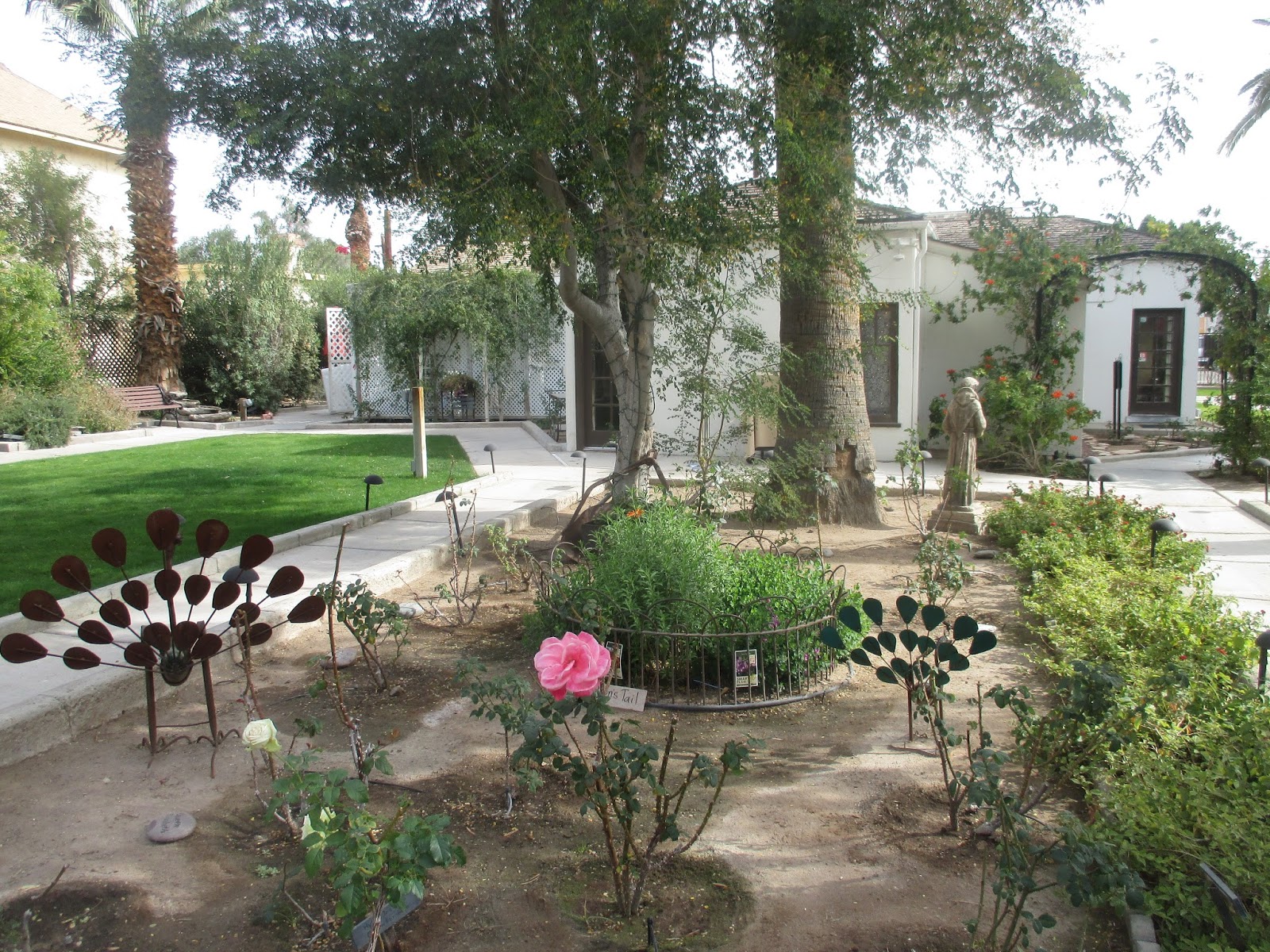

We toured the E.F. Sanguinetti Home Museum and gardens on Tuesday, Feb. 7th (our #1 grandson's 18th birthday).  The gift shop next door was the home of steamboat Captain Jack Mellon from 1874 to 1883.  Sanguinetti is known as the Father of Yuma and had a phenomenal business career here from 1890 to 1946.  His rose garden was his pride and joy.  Now weddings and other special events are held in the garden.  There is also a lovely outdoor cafe and gardens behind the home and several quaint little shops in the back alley.


Sanguinetti was born in 1867 and left home penniless at the age of 15.  He worked as a store clerk when he arrived in Yuma for $40 a month plus room and board.  Each month he sent $33 home to save and kept $7  for his living expenses.  After four years he bought a partnership in the store when he was 19.  By 1898 he was the sole owner and the largest employer in the area, eventually owning or co-owning over 30 businesses.  From real estate to farming operations to mining equipment to an ice plant and public utilities, he served almost all the needs of the residents and businesses alike.  He had one major setback when he invested heavily in cotton and prices dropped considerably in WWI.  His losses were upwards of $1 million and his financial advisers pushed him to claim bankruptcy, but he refused.  It took him 20 years, but he repaid everyone of his debts.  His businesses at one time employed 200 residents.  In the late 1800's mining was a big industry in Arizona, a veritable Arizona Gold Rush.  Major mines like La Fortuna, Kofa (King of Arizona) and North Star mining camps needed equipment supplied by the Sanguinetti General Store.  He also provided wagons and mules that delivered the supplies, at one time owning 400 mules.  When not hauling freight, they were used to clear and level Yuma Valley for farming.  Gold from every mine came through the store.  In 1890 he bought and reopened the Castle Dome silver and lead district, one of the oldest and most productive mining districts in Yuma County.  An estimated 10,000 tons of lead plus 500,000 ounces of silver, along with gold, copper and zinc, were pulled from the district.  He spearheaded many developments that brought Yuma into the 20th century.  He organized the first public utility generated with a 20 kw. generator fueled with mesquite logs and founded the Chamber of Commerce.  When the Southern Pacific Railroad was planning to build new tracks into Yuma, he recommended they build a levee to protect the tracks from floods, which also protected the town from spring floods.  The new tracks and levee facilitated the building of the first dam on the Colorado River - Laguna Dam, which instigated the first vehicle bridge across the Colorado in 1915.  It was the first time automobiles could drive from Los Angeles straight to Miami, thus the name Ocean to Ocean Highway Bridge.  It was reported at the time that the bridge had been badly needed, since the traffic had increased to one car everyday!  He also supported the building of the municipal airport.


Postmortem photography became fashionable during the Victorian Era.  The dead were immortalized by posing in photographs with living relatives.  It was often the only family photo.


  The lady sitting in the chair in this picture is dead!


Then we walked down the block to the new City Hall.  Just inside are murals showing the past and present with the Village of Yuma 1876 and homes and businesses from the late 1800's and the surrounding mountain ranges.


In the foyer is the City of Yuma airplane and the car that were used to set a new world record in 1949.  The story was carried in papers, magazines and on radio around the world.  The two pilots were in the air non-stop 46 days and broke the world endurance flight record.  They flew almost 90,000 miles without a complete oil drain, just adding as needed.  They got a tremendous ovation by a crowd of 10,000 when they finally landed October 10, 1949.  


This picture shows how they refueled and handed up lunches.  Traveling at 75 mph the refueling crew handed up gas to the flyers.  They used over 9,000 gallons.


They had a lot of paintings in the hallways by local artists.  This one was my favorite, Gila Mountain Sunrise by Sally Bell.  Yuma is surrounded by several mountain ranges including, the Chocolate Mountains and Muggins Mountains Wilderness and the Kofa Mountain Range and Wildlife Refuge.


Then we stopped by the old City Hall, but there wasn't much here, just a few old black and white pictures of the original town.


We parked next to this 1948 Jeepster at Walmart.  Thursday we met up with our friends from Montana, Duane and Paula, at Carol's house for a nice visit.  We were supposed to meet up for lunch at La Fonda's on 3rd St. and 10th Ave, but they went to La Flor on 10th St. and 3rd Ave by mistake.  We had both already gotten tables and drinks by the time we figured it out, so we had lunch separately and met up afterward.  What are the odds there would be two Mexican restaurants on the corners of 3rd and 10th with such similar names?  I hit the flea market on Saturday one last time before we left Yuma.


We see all kinds of campers from really old junkers to beautiful palaces, but once in a while we see something very unusual.  There was a single guy staying in this little homemade number.  It had lids on both ends that opened on top like a dumpster that he had full of stuff.  I'm not sure how there was enough space in there for a bed, but I guess it was working for him.

Tuesday, Valentine's Day, we moved to Emerald Cove Campground on the east side of the Colorado River about six miles from Parker, Arizona.  We are parked right on the river and will be here two and a half weeks, then to Verde Valley between Sedona and Phoenix for a few days to visit friends Jim and Claudia, and Casa Grande for a few days to visit with Julie, and back to Yuma.  Then maybe Palm Springs, up to John's sister's and onward north as the weather gets warmer.

Looking forward to seeing friends and family again this summer.
Tarra

Friday, January 13, 2017

Palm Springs & Pismo Beach Family Christmas

Sunday, Dec. 11th - Saturday, Jan. 7th

We arrived at the Palm Springs Thousand Trails campground on Sunday afternoon where I went to water aerobics every day and enjoyed it very much.


We went to the Coachella Valley History Museum in nearby Indio.  This should take you back to the 1950s.  Recognize the Betty Crocker Cookbook in the background?  Everyone had one.  And everyone had ash trays!  General Patton's wife, Beatrice, lived in a house that is still here in Indio, while he trained his troops in nearby Camp Young for the invasion of North Africa.


More washing machines that make me ever so grateful for the times we live in now.  Can't have been much better than beating them on the rocks in the river and spreading them out on bushes to dry, as we actually saw them doing when we visited Peru.  How very lucky we are to live in this country!


An unusual artifact at the museum is this desert submarine.  They were first built in the early 1920s in the valley and stayed cool by using just evaporative cooling.  The metal walls were covered in burlap and kept wet by a center pipe that trickled water down over the burlap walls to cool the interior by at least ten degrees. 


 The first ones were designed as 8' x 10' sleeping rooms.  Others were built as cooling rooms for produce and milk.  A much later model served as a 4-bed ward in one of Indio's hospitals.  By the late 1950s, 100 or more were still being used as sleeping rooms for Southern Pacific Railroad crews.  Indio was chosen as the halfway point between L.A. and Yuma when the railroad was completed in 1876.  In the 1870s it was called Indian Wells.


1912 offshoot crate built from the mid-ribs of date palm fronds from Egypt.  The date gardens (not groves) in this area were started from offshoots of varieties of dates grown commercially in North Africa and the Middle East.  They were introduced to the Coachella Valley in the early 1900s. 


One of civilization's oldest cultivated crops, dates have been central to life in the Middle East for over 5,000 years.  Date oases were the center of life and economy for the local tribes.  Women ate them to help with labor pains, one of many medicinal uses.  They are the traditional food first eaten after the breaking of the fast of Ramadan.  The Mishaba (prayer beads) is made out of cut and polished date seeds, 99 for each of the 99 names of Allah to be recited in prayer.  They are mentioned many times in the Bible, Torah and Quran.  Date palms are dioecious, there are both male and female trees.  A commercial garden needs one male tree for every 48 to 50 female trees.  The offshoots are true to parent variety and essential to having a commercially viable date garden.  The offshoots help growers to control variety and sex of the trees.


They are a very labor intensive crop and require skilled workers for the precise process of all aspects of the growth cycle.  They have to climb up in the trees and pollinate them by hand by putting a pollen saturated cotton ball into the female blossom in March and April.  They do thinning and tie them down to the palm fronds in May and June to support their increasing weight and cover the bunches with paper or cloth bags to protect them from rain and birds in July.  Harvest takes place August through December and clean up, pruning and de-thorning of the palms is in December and January.  Grapes also thrive here and are the most profitable crop in the Coachella Valley with over 8,700 acres of vineyards. Grapefruit and other citrus are also grown here.


They have had a National Date Festival since 1921 and it took on a Middle Eastern flair in the 1940s.  The title of Queen Sheherazade is based on the narrator from 1001 Arabian Nights, which is still performed every year with a three course dinner, tickets are $85, only 100 seats available.  A new costume is made each year for the Queen and elaborate floats are made for the parade to highlight their agriculture industry and the date shakes always sell out.  I buy an 11-pound case of dates every year and I may buy a second case this year.  They are delicious!  I like to cut them in half, spread a little soft tangy cheese in them and put a pecan on top.  Yum, Yum!


Saturday, Dec. 17th we went to Cabot's Pueblo Museum at Desert Hot Springs.  Cabot Yerxa's masterpiece, built mostly from found materials between 1941 and 1950, was his home and personal museum until his death in 1965.  He salvaged materials from abandoned cabins, collected driftwood from the Salton Sea and made bricks and cement from the local soil.  Some exterior walls were made from old enameled metal signs.  Cabot was Dutch and born in the Dakota Territory in 1883, an adventurer who traveled across much of the world and through many cultures, including Native American.  He made and lost money on several ventures and lost his fortune in the 1913 California citrus frost.  He then traveled by train to the desert, bought a $10 burro and homesteaded 160 acres.  Water was scarce.  The sign below describes how precious it was and how careful they were not to waste any.


  He walked a 14 mile round trip daily to get water until in 1914, with advice from the native Indians, he dug a well and found water that came out at 132 degrees.  Months later 600 yards away he dug a new well and discovered cold water.  In celebration he named his homestead "Miracle Hill".   He tried to share news of his discovery, but no one believed him.  It was not until 1932 when the therapeutic qualities of the hot springs were realized.  The area rapidly grew into one of the most popular health centers in the world.


The sign says "Ancient Weather Rock.  When rock is wet it's raining.  When rock is white it's snowing.  When rock is hard to see it's foggy.  When rock is moving it's windy or there is an earthquake.  Rock is never wrong."  More trustworthy than today's weather forecasters.


Desert Hot Springs is one of the most geologically unique places in the world.  It sits on the North American Tetonic Plate.  All the other cities in Coachella Valley are on the Pacific Tetonic Plate.  The plate's western edge goes all the way to Japan.  It is the largest plate on the planet and stretches from the Arctic Pole to the Antarctic Pole.  The area between the two plates is the San Andreas Fault.  The natural separation of these two plates ensures Desert Hot Springs has world-famous hot mineral water and internationally recognized award-winning drinking water.  The hot water aquifers reach temperatures as high as 200 degrees.  People from all over the world have been coming to soak in the waters since 1946.  There are over 20 mineral water spas in the community.


The benches along the right side of his meditation area are made from broken slabs of concrete sidewalks, seats and backs, quite nice and natural looking in the surroundings.


The pueblo is on a hill overlooking the town of Desert Hot Springs with views of Southern California's two tallest mountains, Mt. San Gorgonio 11,503" and Mt. San Jacinto 10,834'.


He used tires to make steps and prevent erosion when the water gushed through the valleys.


Waokiye was carved on site by Peter Toth in 1978 as part of his "Trail of the Whispering Giants", intended to raise awareness of the spirit, culture and plight of Native Americans.  Toth created at least one monument in each state, two in Canada and one in Hungary, his birthplace.  It is carved from a fallen Sequoia with an incense cedar feather.  It is 43 feet tall.  In the Lakota Sioux language waikiye is said to mean traditional helper.  For friends and family, there is one in Aberdeen, Mandan, Iowa Falls and Sharon, PA.  If you would like to see pictures of them all alphabetically by state go to www.dcschumaker.com/statues.htm 


Thursday, Dec. 22nd we headed over to Pismo Beach where our kids and grands and Aunt Kathy were meeting us for Christmas.  This is Aunt Kathy doing her traditional reading of the Twas the Night Before Christmas.  Dallas is giving her a quizzical look while Tally is wearing Kathy's elf hat that sings, dances and jingles.  The hat was a big hit even if they couldn't wait for the story to be over, so they could start opening presents.


On Monday after the big hoopla of Christmas was over, we drove over to nearby Pismo Beach State Park to see the thousands of monarch butterflies that migrate here each winter.


We were lucky that it was a very nice sunny day and they were starting to open up and fly around.  You can see the big clusters of them hanging in the eucalyptus trees.  They look like dead brown leaves when their wings are folded shut.  They won't open their wings and fly around until it gets up to about 70 degrees.  I don't blame them.  I won't either.  I'll never be able to live through the northern winters again!  I'm totally spoiled.


A fun family day.  Like the butterflies, Tally wasn't sure if she wanted to spread her wings for the camera.


Tuesday Kathy took us to Avila Farms where the kids could feed and pet the animals and we could do a little shopping for treats and souvenirs.


Dawn catching a photo of the kids feeding the sheep.


Dallas was having a blast!


Tally petting the soft, fuzzy goats.


Next we went to the Avila Beach Pier and playground.


Climbing on the dolphins was the highlight here.


No such thing as too much fun!  Right Mom?


Then Kathy took us to the Custom House, a seafood restaurant at Avila Pier, where I had the best shrimp ever.  We will definitely go there again.


Next we went to Dinosaur Caves Park where the girls played in the dinosaur eggs and Dallas was confined to the stroller, so he wouldn't fall off a cliff.


Enjoying the view of the cliffs along the walkway.


We could see the sea lions on one of the rocks out there and hear their boisterous barking.


This rock was covered with pelicans.


Wednesday we drove north an hour or so to see the elephant seal birthing grounds.  The beach is just covered with seals.


Bull, mother and baby.  The bulls occasionally get into fights to protect their territory and harems.


Hearst Castle is just across the road only a couple miles south, so we went there next for the tour.  We have been there several times before, so John stayed with the "D" man to keep him out of trouble and the rest of us went on the tour.


View down the hill toward the beach where the elephant seals are.


View of the Neptune Pool that was empty and under construction while we were there.  There is also an incredible indoor pool.


For our kids who didn't get to see what the pool looks like when it is repaired and full of water.


  Thursday we just spent some relaxing time at the beach and hot tubbing.  The kids found lots of seashells, especially sand dollars, to take home with them.  The last evening of our family coastal Christmas.  Friday morning the grands headed home, but Dawn stayed with us for a few more days.  We headed over to Kathy's for the weekend and then to Casa de Fruta Campground near Gilroy, garlic capitol of the world.  Tuesday we drove a couple hours up to San Francisco to show Dawn around a bit.  We drove over the Golden Gate Bridge with a view of the bay and Alcatraz and did a short hike in the rain at John Muir Redwoods.  Then we drove along Fisherman's Wharf and down Lombard Street, the crookedest street in the world.  We ate at a restaurant called The Fish at the docks in Sausalito and headed back to camp.


Wednesday we drove about an hour to San Jose to tour the unique Winchester House, supposedly one of the most famously haunted residences in the world and a very confusing labyrinth of 160 rooms. 


We had done the tour before, so John bowed out, but Dawn and I did the house and garden tour, plus the behind the scenes tour that took us through the basement with low ceilings, thus the hard hats.  This is the water tower or pump house,


The house had 160 rooms when we first toured it, but they have since discovered another room in the attic.  They moved it down into the courtyard and turned it into a shooting gallery with 38 targets, so you can try to shoot the ghosts that supposedly haunt the house.  "During the move of this room from the attic to the courtyard, a rifle accidentally went off, bringing the spirits out of the woodwork and activating some of the many antiquities around the attic."  Hmmm, I'm a skeptic, but what do I know?  You can walk around the courtyard and gardens and through the gun museum without buying a ticket.  The gun collection contains an example of each model manufactured with the Winchester name beginning in 1866, including those imported from England.


Some of the Christmas decorations were still up.  They were just starting to take them down.


Mrs. Winchester was upset about all the Indians that had been killed by the rifles her husband had manufactured.   A medium supposedly told her the only way to keep the ghosts away was the keep the house under continuous construction, so she did, 24 hours a day for 38 years!  It was a great place to be employed.  There was always another project and she paid well.  She had a 160 acre orchard farm with apricot, plum and walnut trees and some of the workers lived here.  Thirty rooms were structurally damaged during the San Francisco earthquake of 1906.  She just closed them off and never used them again and just kept on adding rooms. 


Notice the end of the tower painted black on the left side of the picture.  Everything that was unfinished with plans for adding on when she died are painted black.  Notice the door to nowhere on the second floor on the far right side.  If you walked out of it, you would fall straight to the ground.  There are lots of strange and unexplained features like that in this house.  A very interesting tour.


Dawn snapping a photo of the grape arbor in the back courtyard.


The flowers were pretty much out of season,


but I managed to get a few nice shots.


Model of the house made out of candy for Christmas.


Me under a palm tree in the parking lot.  They are my favorite kind of tree, because if you are near one, you are warm.


We went to El Pollo Loco (the crazy chicken) for lunch and stopped by the San Jose Rose Garden before we left town.


It was also pretty much done blooming for the season,


but I got a few more nice pics here, too.


Thursday we drove over to Monterrey Bay.  We were hoping to go on a whale watching tour, but they were canceled for the afternoon, because the swells were too big out in the ocean. So we drove the famous 17-mile drive to Carmel along the coast and past Pebble Beach and two other golf courses.  Then we ate at Louie Linguini's on Cannery Row and checked out a few shops and headed back to camp.  Friday we headed back to Kathy's and Dawn took us all out for supper at Panera.  Saturday morning Dawn flew home from Fresno and we headed straight back to Yuma.  John had cracked a tooth and went to Mexico first thing Monday morning and had it pulled.  I think we will just be relaxing in Yuma for a while now, enjoying the pool and sunshine and going to lots of movies.

Hope everyone is keeping warm.
Over and Out,
Tarra